
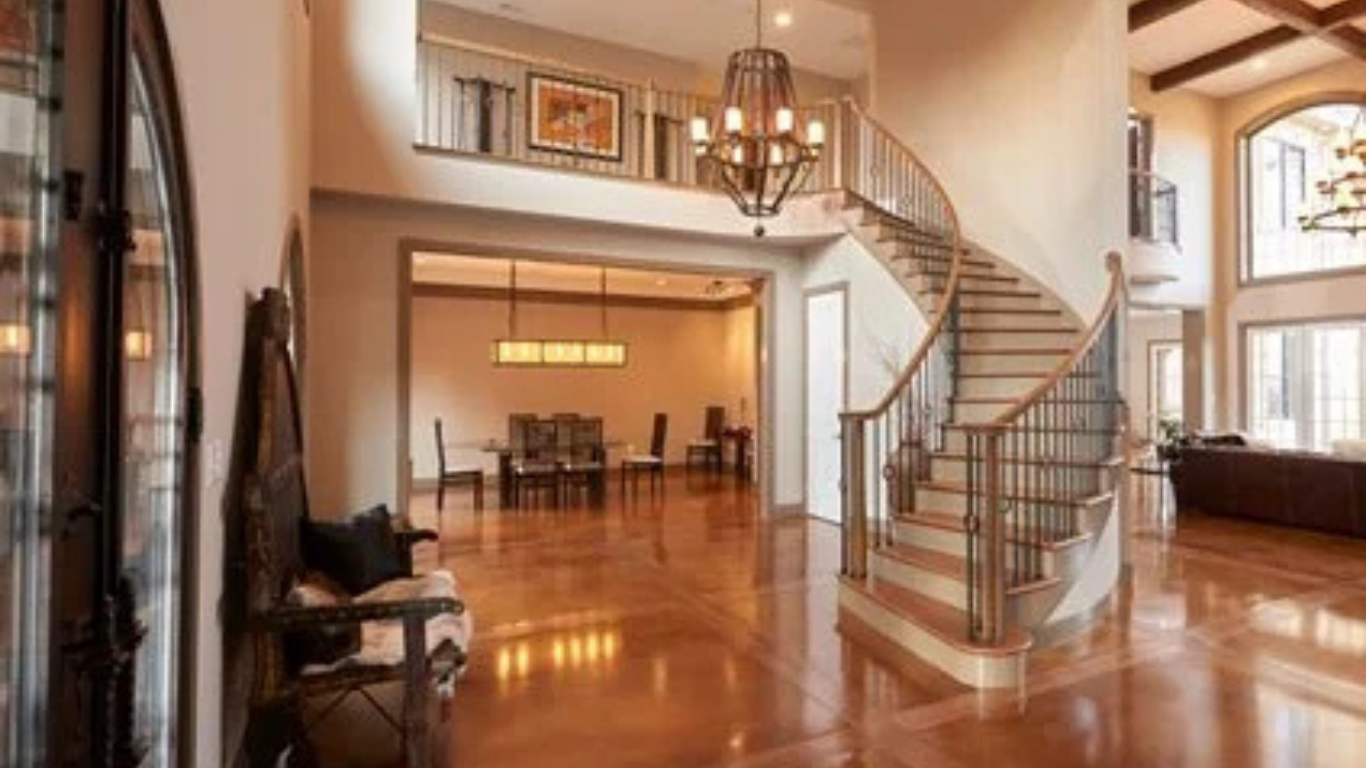
In the world of contemporary design, few surfaces manage to feel both industrial and refined at the same time. Polished concrete floor finishes have quietly become one of those rare materials that work equally well in a high-end loft, a bustling retail space or a family kitchen. Far from the cold, utilitarian look many still associate with concrete, today’s polished versions offer a spectrum of sheens, textures and aggregate exposures that can feel as soft as stone or as dramatic as terrazzo.
What keeps people returning to this finish is its honesty. It is the slab itself, refined rather than covered. No coatings to peel, no planks to warp, just a surface that grows more characterful with time. In an era of fleeting trends, polished concrete floor finishes stand out for their longevity, low upkeep and quiet versatility.
A Brief History of the Finish
Concrete itself is ancient. The Romans used a remarkably similar material for the Pantheon and Colosseum, while earlier examples of polished lime concrete floors have been traced as far back as Neolithic settlements. Yet the modern process of diamond-polished concrete is far younger. In the early 1990s a stone-polishing crew working on a palace in Tunisia accidentally dry-polished a concrete slab. The result was so striking that the technique spread rapidly, first through commercial warehouses and then into design-conscious homes and retail spaces.
blob:https://wyomeaning.co.uk/b70c5b70-04b9-4de0-b522-5bb732e2017aMeta Boxes
Use up and down arrow keys to resize the meta box pane.Move upMove down
By the 2000s, specialised densifiers and progressive diamond tooling had turned what began as an industrial accident into a refined architectural finish. Today it appears in everything from London galleries to countryside barn conversions, valued as much for its sustainability credentials as its aesthetic.
How Polished Concrete Floor Finishes Are Created
The transformation begins with a sound concrete slab—ideally around 30 N/mm² strength and properly cured. Specialist planetary grinders fitted with metal-bond diamond segments first remove surface imperfections, coatings or laitance. This coarse grinding stage levels the floor and, depending on the desired look, begins to expose the aggregate.
Chemical densifiers, usually lithium or sodium silicate, are then applied. These react with free lime in the concrete to form a harder, denser surface that resists abrasion and dusting. From here the process moves to resin-bond diamond pads of progressively finer grits—typically from 200 through to 800, 1500 or even 3000 grit. Each pass refines the surface further, closing pores and increasing reflectivity.
The final sheen is determined by how far the polishing sequence is taken and whether a protective guard is applied. The entire process can take several days depending on floor size, existing condition and the level of finish specified. When done well, the concrete itself becomes the finished floor—no topical coating required for basic performance, though many installers add a stain-resistant guard for kitchens or high-traffic zones.
Understanding the Different Polished Concrete Floor Finishes
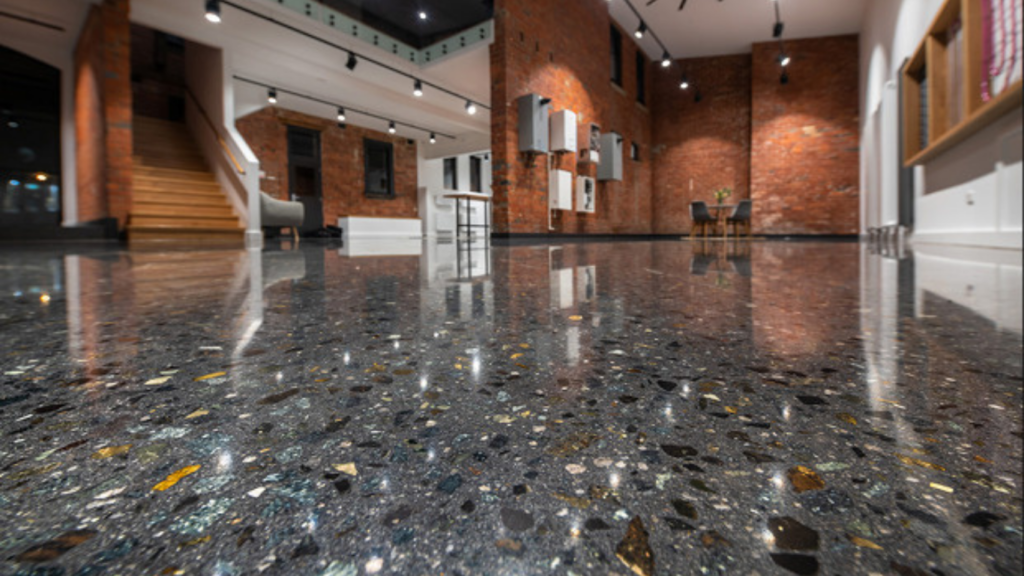
Two main variables shape the final appearance: sheen level and aggregate exposure.
Aggregate exposure adds another layer of choice. A cream finish leaves the surface paste largely intact, producing a smooth, cloudy appearance with subtle movement. Salt-and-pepper reveals fine aggregate just below the surface for a speckled look. Full or deep exposure grinds further to show larger stones, creating a terrazzo-like character that feels richer and more decorative.
These options can be combined with integral colour, dyes or dry-shake hardeners, giving designers a wide palette while remaining firmly within the material’s natural language.
Why Designers and Homeowners Keep Choosing Them
Durability sits at the top of the list. A properly densified and polished floor can last the lifetime of the building. It resists heavy foot traffic, impact and most chemicals far better than many surface-applied systems. Maintenance is straightforward: regular dust-mopping and occasional damp-mopping with a neutral cleaner usually suffice. No waxing cycles, no re-coating every few years.
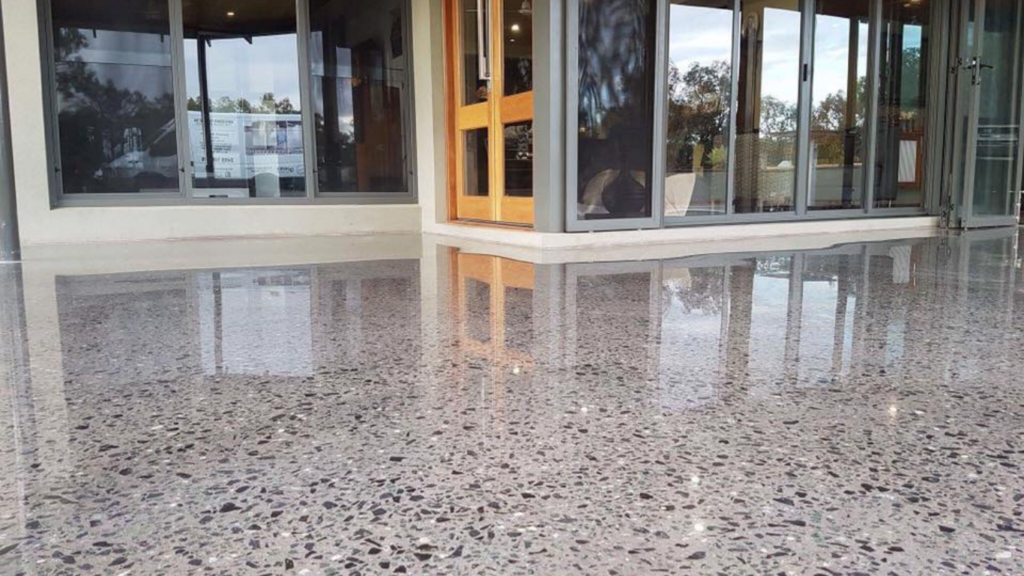
The finish also plays well with underfloor heating. Concrete’s thermal mass conducts heat efficiently, delivering responsive warmth without the insulation layers required by many timber or vinyl floors. In open-plan spaces the reflective quality of higher sheens can bounce natural light deeper into a room, reducing the need for artificial lighting.
From a sustainability perspective, polished concrete floor finishes score highly. They use the existing slab rather than adding new materials that will eventually need replacing. No VOC-heavy coatings are required for the core process, and the long service life keeps waste out of landfill.
Practical Considerations and Potential Drawbacks
No flooring is perfect for every situation. Polished concrete is hard underfoot; prolonged standing can feel tiring, and dropped glassware is unlikely to survive. It can also feel cool in winter unless underfloor heating is present. Acoustically, the hard surface reflects sound, so soft furnishings or acoustic treatments help in larger rooms.
Slip resistance varies with sheen. Matte and satin finishes generally perform better when wet; high-gloss surfaces may need additional treatments or careful specification in wet areas. Existing slabs must be assessed for structural soundness, moisture content and previous coatings—poor substrate preparation remains the most common cause of disappointment.
Colour consistency can also vary. Concrete is a natural material; slight shifts in tone or aggregate distribution are normal and often celebrated as part of the character. Those seeking absolute uniformity may prefer a different system.
Costs, Installation and What to Expect
In the UK, polishing an existing sound slab typically ranges from £40 to £120 per square metre, depending on the depth of grinding, sheen level and any repairs or colour work required. New pours finished to a polished standard often sit higher, sometimes £120–£150/m² all-in, because the mix design, placement and curing must be carefully controlled.
Installation is best left to specialists. The process is dusty and noisy during grinding stages, and sequential timing of densifiers and polishing steps matters. For new builds, involving the polishing contractor early allows the concrete mix and power-trowelling to be optimised for the desired finish.
Looking After the Floor
Day-to-day care is simple. Sweep or dust-mop regularly; damp-mop with a pH-neutral cleaner when needed. Avoid acidic products, which can etch the surface. In commercial settings, automatic scrubbers with soft pads work well. Every few years a light re-burnish or re-application of a protective guard can restore sheen in high-traffic zones without a full re-polish.
With this modest routine, a polished concrete floor can remain serviceable and attractive for decades.
Current Appeal and Design Applications
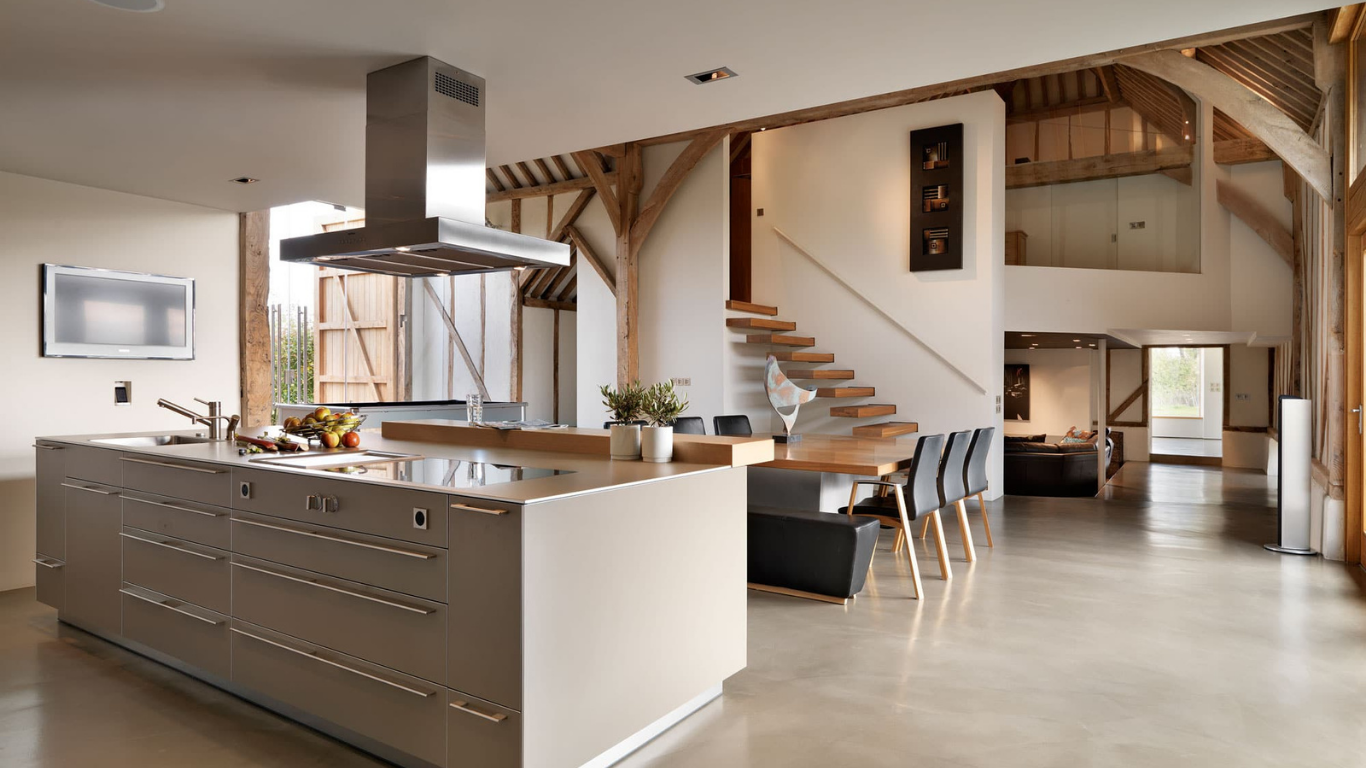
Today the finish appears across residential kitchens, open-plan living areas, retail showrooms, galleries, offices and even high-end garages. Designers favour it for its ability to bridge industrial and domestic aesthetics, and for the way it pairs with timber, steel, plaster and natural stone. In the UK it has found particular favour in contemporary renovations and extensions where continuity of floor plane and underfloor heating efficiency matter.
Quick Facts
| Detail | Information |
|---|---|
| Material base | Portland cement concrete with densifiers |
| Typical process | Multi-stage diamond grinding and polishing |
| Common sheen levels | Matte, satin, semi-gloss, high-gloss |
| Aggregate options | Cream, salt-and-pepper, full exposure |
| UK installed cost range | Approx. £40–£120/m² (existing slab) |
| Expected lifespan | Decades to the life of the building |
| Maintenance | Low – dust-mop and neutral cleaner |
| Best suited for | Interiors – residential, retail, commercial |
A Lasting Material Choice
Polished concrete floor finishes endure because they ask very little while delivering a great deal. They turn a structural necessity into a finished surface of real character. In an age of disposable finishes and short product cycles, that combination of honesty, performance and quiet beauty continues to resonate with architects, designers and homeowners alike.
conclusion
The material rewards careful specification and skilled installation, yet once in place it largely looks after itself. Its influence can be seen in the growing preference for exposed structural materials and in the way contemporary interiors favour longevity over novelty.







Leave a Reply