
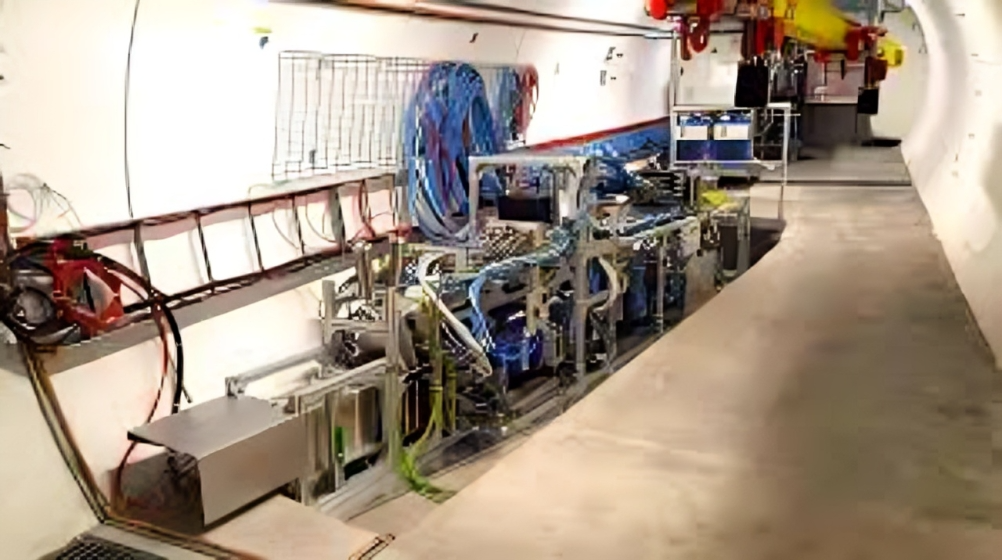
In the vast underground tunnels of CERN’s Large Hadron Collider (LHC), scientists have installed a unique detector known as faser, designed to catch elusive particles that travel far from the collision points. This compact yet powerful instrument opens a window into physics beyond the Standard Model, hunting for signs of dark matter, hidden sectors, and other mysteries that could reshape our understanding of the universe.
Origins and Motivation Behind faser
Particle physics has long relied on massive detectors like ATLAS and CMS to study high-energy collisions at the LHC. These giants capture particles produced right at the interaction points, where protons smash together at near-light speeds. However, not all potential new physics manifests in that immediate vicinity. Some theoretical models predict long-lived particles—ones that decay after traveling hundreds of meters. Traditional detectors miss these because they’re focused on the central region.
That’s where faser comes in. Conceived in the mid-2010s by a team of physicists looking to exploit unused space in the LHC infrastructure, faser was proposed as a cost-effective way to probe this untapped territory. The idea stemmed from recognizing that the LHC produces an enormous flux of particles shooting forward along the beamline. Many of these are known particles like muons or neutrinos, but hidden among them could be exotic ones from new physics.
The faser collaboration formed quickly, drawing experts from institutions worldwide. They saw an opportunity in the TI12 tunnel, a disused service tunnel about 480 meters from the ATLAS interaction point. By placing a detector there, faser could intercept particles that survive the journey through magnets and absorbers meant to bend and filter the beam. This forward position is key; it allows faser to search for weakly interacting particles that barely interact with matter, making them hard to spot elsewhere.
Approval came swiftly from CERN in 2019, and construction began soon after. What makes faser remarkable is its modest scale compared to other LHC experiments. Weighing in at just a few tons and spanning about 7 meters, it’s a fraction of the size and cost of its counterparts. Yet, its potential impact is enormous, demonstrating how clever placement and targeted design can yield big results in science.
The Design and Components of the faser Detector
At its core, faser is engineered for precision in a challenging environment. The detector sits in a narrow tunnel, exposed to high radiation and magnetic fields from the nearby beamline. To handle this, engineers incorporated robust materials and shielding.
The main faser detector consists of several key modules. Starting from the front, there’s a veto system made of scintillators to reject charged particles like muons that could mimic signals. Behind that lies the preshower detector, which helps identify electromagnetic showers. The heart of faser is its tracking stations, using silicon strips and scintillating fibers to trace particle paths with micrometer accuracy.
Further along, an electromagnetic calorimeter absorbs and measures the energy of electrons and photons. Finally, a hadronic calorimeter captures hadrons, providing a complete picture of incoming particles. The entire setup is aligned along the line-of-sight to the collision point, ensuring it catches forward-going particles.
One innovative aspect of faser is its use of a decay volume—a 1.5-meter empty space where long-lived particles can decay into detectable products. This is crucial for spotting signatures like displaced vertices, where decays happen away from the primary collision.
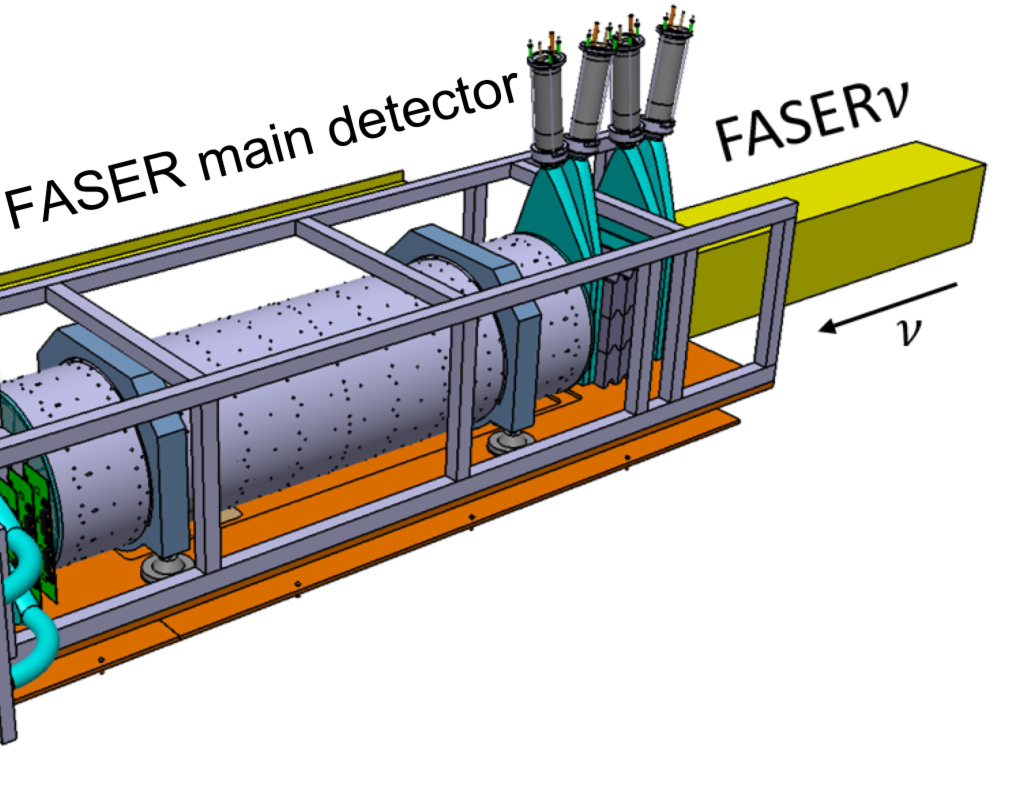
FASER neutrino detector | FASER: ForwArd Search ExpeRiment at the LHC
The image above illustrates the layout of the faser neutrino detector submodule, showcasing how components fit together in a compact form.
Powering all this is sophisticated electronics for data readout and triggering. faser operates in sync with the LHC’s bunch crossings, selecting events that match expected new physics signals. Data is then piped to surface computers for analysis, where machine learning algorithms help sift through noise to find anomalies.
Upgrades have already enhanced faser. The FASERnu extension, added in recent years, focuses on neutrino interactions, turning faser into a multi-purpose tool. This submodule uses tungsten plates interleaved with emulsion films to capture neutrino tracks with unprecedented detail.
How faser Operates Within the LHC Ecosystem
The LHC accelerates protons to 6.5 TeV per beam, colliding them at four main points. At ATLAS, these collisions produce a spray of particles, most deflected by magnets. But neutral or very forward-charged particles continue straight, passing through absorbers and into the far-forward region where faser waits.
During LHC runs, faser collects data passively, waiting for rare events. Its location shields it from the bulk of debris, but it still sees a high rate of background from muon halo and neutrino interactions. To combat this, faser employs tight selection criteria, looking for events with high energy deposits and no incoming tracks—hallmarks of decaying long-lived particles.
Operationally, faser integrates seamlessly with the LHC schedule. When the collider is running, faser’s systems activate, monitoring in real-time. Downtimes allow for maintenance and data calibration. The collaboration uses simulations based on tools like Pythia and Geant4 to predict backgrounds and signal efficiencies, refining their searches accordingly.
One challenge for faser is the sheer volume of data. Though smaller than other experiments, it still generates terabytes during runs. Advanced computing clusters process this, applying cuts to isolate potential discoveries.
Scientific Objectives of faser
faser targets a range of beyond-Standard-Model phenomena. Primarily, it searches for light, weakly coupled particles like dark photons, axion-like particles, and heavy neutral leptons. These could mediate dark matter interactions or explain neutrino masses.
For instance, dark photons might decay into electron-positron pairs after traveling to faser. By measuring their energies and angles, physicists can infer masses and couplings, testing models that extend the Standard Model.
faser also probes high-energy neutrinos from the LHC. Unlike cosmic neutrinos detected at IceCube, LHC neutrinos come from charm decays, offering a controlled source to study their properties. FASERnu aims to detect thousands of such interactions, measuring cross-sections with precision.
Beyond new particles, faser contributes to Standard Model measurements. It studies forward production of mesons, helping refine QCD calculations. This data aids in understanding cosmic ray air showers, where similar processes occur.
In broader terms, faser complements other forward experiments like SND@LHC, exploring parameter space inaccessible to central detectors. Together, they cover a wide range of masses and lifetimes, increasing chances for breakthroughs.
Key Discoveries and Results from faser
Since starting data-taking in 2022, faser has delivered exciting results. Early on, it observed its first neutrino candidates, confirming the presence of high-energy neutrinos at the LHC—a milestone in collider neutrino physics.
In 2023, faser reported the detection of electron and muon neutrinos, with energies up to several TeV. These observations matched predictions but provided new insights into forward neutrino production. The collaboration published cross-section measurements, constraining models of charm quark fragmentation.
On the new physics front, faser has set stringent limits on dark photons and axion-like particles. For masses around 10-100 MeV, it excludes couplings down to 10^-5, closing gaps in previous searches. These limits impact theories of dark matter portals and hidden valleys.
A notable highlight was the 2024 analysis of displaced decays, where faser identified events consistent with long-lived particle signatures. While not yet a discovery, these hint at possible new physics, prompting further scrutiny.
faser’s data also informed cosmic ray physics, improving models of atmospheric neutrino fluxes. Collaborations with astrophysicists have used faser results to better predict backgrounds for underground detectors.
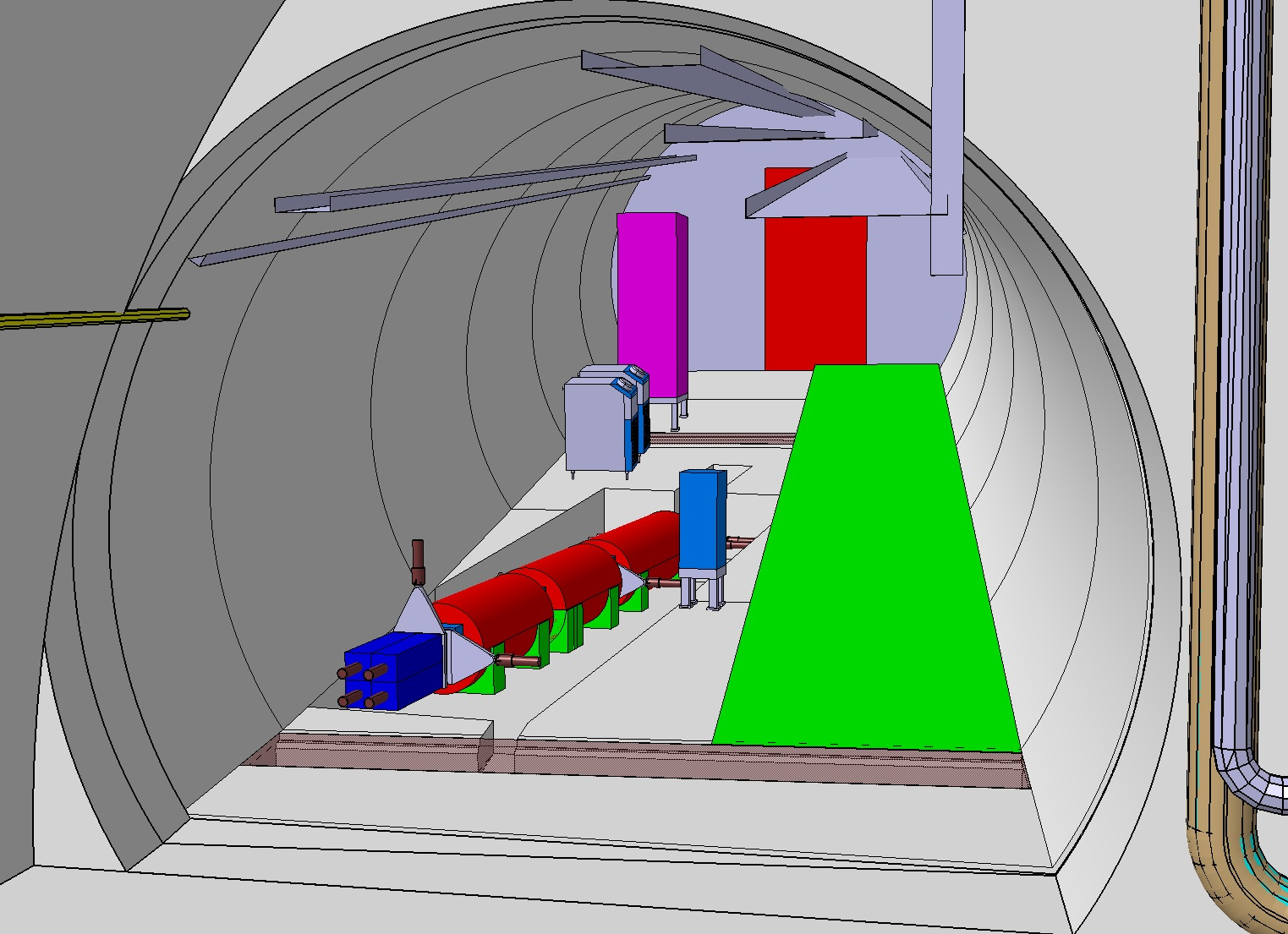
Location | FASER: ForwArd Search ExpeRiment at the LHC
This visualization shows the faser installation within the LHC tunnel, highlighting its strategic placement.
Challenges and Innovations in faser’s Development
Building faser wasn’t without hurdles. The tunnel’s tight space demanded compact designs, leading to custom silicon trackers and scintillators. Radiation hardness was another issue; components had to withstand doses equivalent to years of exposure.
Innovations included using 3D-printed supports for alignment and fiber-optic readout to minimize electronics in the radiation zone. Software-wise, faser pioneered AI-based event reconstruction, speeding up analysis by factors of ten.
Collaboration dynamics played a role too. With over 100 members from 20 institutions, coordinating across time zones required efficient tools like shared simulations and virtual meetings.
Looking ahead, faser faces the High-Luminosity LHC upgrade in 2029, which will increase collision rates. To cope, plans include enhanced triggering and more robust calorimeters.
The Broader Impact of faser on Physics and Society
faser exemplifies how targeted experiments can advance science without massive budgets. Its success inspires similar projects at other colliders, like proposed forward detectors at the Electron-Ion Collider.
Educationally, faser engages students through hands-on involvement in detector assembly and data analysis. Outreach programs explain its goals to the public, demystifying particle physics.
Societally, discoveries from faser could influence technology. Insights into neutrinos might aid in medical imaging or geophysics, while new materials developed for detectors find uses in industry.
In the quest for fundamental knowledge, faser reminds us that big questions often require looking in overlooked places. It bridges collider and astroparticle physics, fostering interdisciplinary progress.
Future Prospects for faser and Beyond
As the LHC continues operations through the 2030s, faser is poised for more data. The collaboration aims to accumulate 150 fb^-1 of integrated luminosity, boosting sensitivity to rare processes.
Potential upgrades include larger decay volumes and finer-grained trackers to probe even weaker interactions. FASERnu will expand, targeting tau neutrinos for complete flavor studies.
Beyond the LHC, concepts like faser-inspired detectors at future colliders (e.g., FCC) are under discussion. These could search for heavier long-lived particles.
Ultimately, if faser discovers new physics, it could trigger a paradigm shift, much like the Higgs boson did. Even without, its limits will guide theorists toward viable models.
Conclusion
The faser experiment has already transformed our approach to particle searches, proving that innovation thrives in constraints. By focusing on the forward direction, faser uncovers hidden aspects of the universe, from neutrinos to potential dark sector particles. As it evolves, faser will continue to challenge and expand the boundaries of knowledge, inviting us to question what lies beyond the known. For physicists and enthusiasts alike, faser offers a compelling narrative of curiosity-driven science yielding tangible advances.









Leave a Reply